
This is the third story in Central Asia Solidarity Groups’ 2025 series about our partnerships across Central Asia. Together with ISDS and El-Too, Little Earth’s work shows how local organizations translate knowledge, cooperation, and sustainability into tangible results that improve lives and protect fragile environments. While the earlier stories focused on biodiversity, youth engagement, and cultural environmental action in Kyrgyzstan, this final post takes us to the high mountain villages of Tajikistan, where clean energy and women’s leadership have reshaped everyday life.
In the remote Yagnob Valley of Tajikistan, surrounded by steep mountains and scattered high altitude villages, the organization Little Earth has been working with Central Asia Solidarity Groups (CAG) to bring clean energy, knowledge, and new opportunities to some of the region’s most isolated communities. What began three years ago as an effort to reduce energy poverty and protect the fragile environment of the Yagnob National Natural Ethnographic Park has grown into a model for community driven change, one that links renewable energy, women’s empowerment, and sustainable livelihoods.
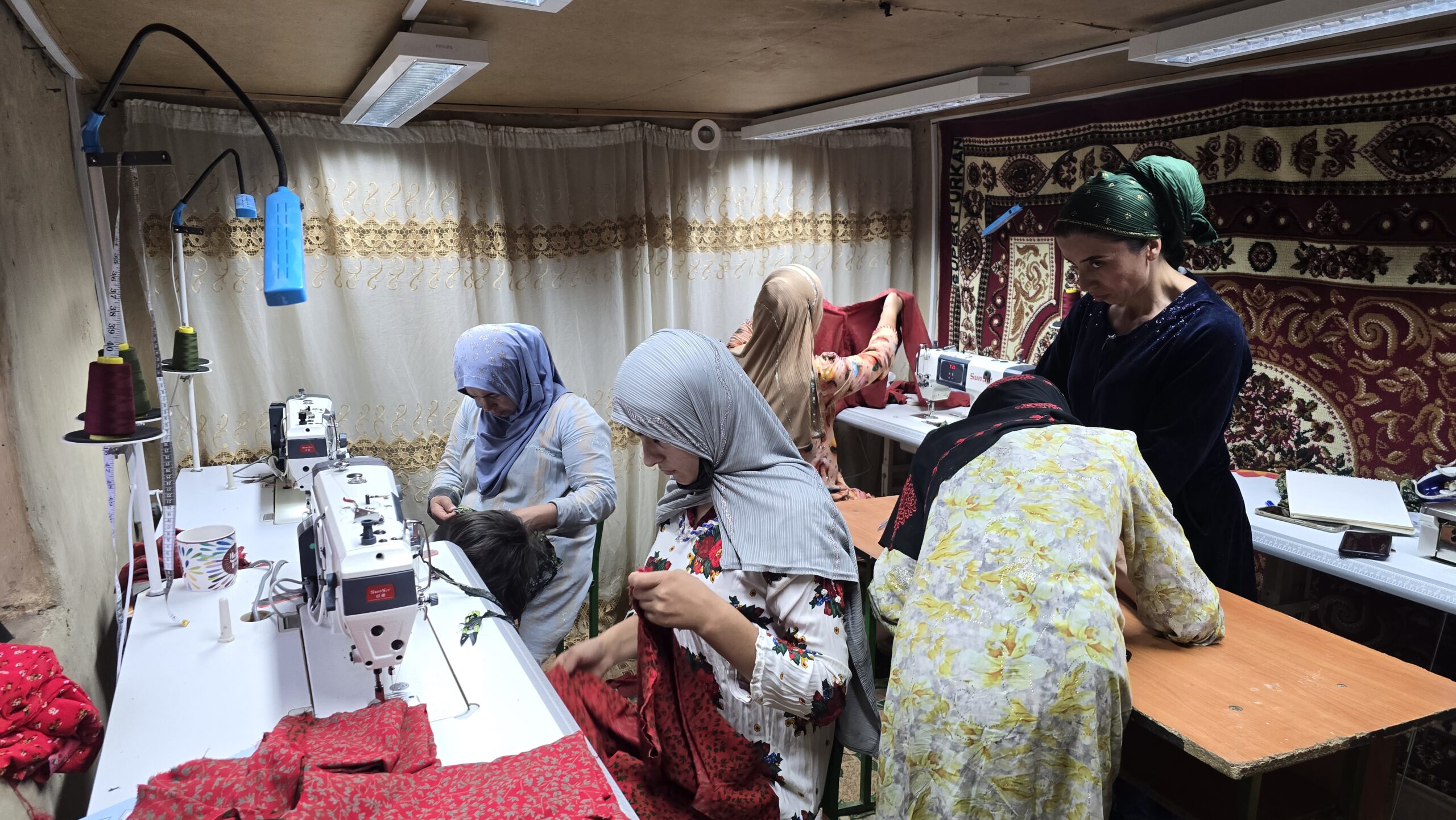
By 2025, the project’s results could be seen in both everyday life and the surrounding landscape. Where families once relied entirely on firewood and dung for heating and cooking, solar energy now powers sewing machines, showers, and lights. In the village of Mahtimain, a solar powered sewing workshop opened its doors, equipped with professional machines and an autonomous 2.4 kilowatt solar system. Six women began working there part time, sewing clothes and souvenirs for income while gaining skills that strengthened their independence. Nearby, a public solar shower with a 250 liter insulated tank became one of the most valued communal spaces in the valley. Dozens of residents, many of them women and children, now have regular access to warm water for the first time.
These are not small changes in a place where winters are long, roads are rough, and resources are scarce. They are practical steps that have eased daily burdens, improved hygiene, and reduced reliance on firewood. Together, the new installations are expected to save around fifty tons of wood each year, cutting carbon emissions and helping to protect the valley’s fragile mountain ecosystem. For the women involved, the project has also meant something less tangible but equally significant: recognition. They are no longer seen merely as recipients of aid but as knowledgeable contributors shaping their communities’ future.
The progress of 2025 built upon steady groundwork laid during the previous two years. In 2023, Little Earth, with CAG’s support, began by distributing efficient rocket stoves and portable solar showers to twenty households, offering immediate relief from smoke filled homes and fuel scarcity. The organization also organized a study tour that took ten women from the Yagnob Valley to meet other organizations in Anzob, Ayni, and Penjikent. For most participants, it was their first journey outside their home villages and the first time they met peers involved in environmental or community work. That experience opened doors, not just literally, but in terms of perspective.
The following year focused on deepening engagement. Training sessions on gender equality and sustainable energy introduced participants to practical tools and to the idea that women could lead change within their own communities. One meeting, in particular, marked a breakthrough. For the first time, a group of women met with the chairman of their local jamoat to discuss issues like sanitation, school conditions, and access to renewable energy. That meeting symbolized a shift that would continue through 2025: women beginning to take part in public dialogue, to speak, and to be heard.
Like ISDS and El-Too in Kyrgyzstan, Little Earth placed strong emphasis on participatory decision making and youth involvement. Younger residents took part in awareness campaigns, assisted with the construction process, and helped document the results. Their participation showed that even in remote valleys, environmental change can become a shared intergenerational effort.
The initiative’s evolution mirrored this growth in confidence. Early in the project, the approach centered on awareness raising and the distribution of clean energy equipment. Over time, it turned into something more participatory and co creative. By 2024, women’s feedback began to shape the project directly. Their proposal to build a greenhouse inspired the construction of new facilities in 2025, including the solar powered workshop and public shower. Communities contributed land, materials, and labour, while Little Earth provided technical expertise and solar technology. This combination of support and co ownership ensured that the new facilities were not external donations but shared achievements rooted in local needs and priorities.
Alongside these tangible results came other, quieter transformations. The project reduced the time women spent collecting fuelwood, improved their health through cleaner air and access to sanitation, and created spaces where they could gather and learn together. The sewing workshop became not just a workplace but a meeting point, a small sun lit room where women exchanged stories, practiced embroidery, and discussed future plans for producing items for visitors and markets beyond the valley. It was the first women run enterprise in the area, and its presence signaled to others that such change was possible.
Environmental impact was equally striking. By replacing firewood and dried dung with solar energy for cooking and heating water, households reduced carbon emissions by more than one hundred tons per year. This shift helped protect local forests and the fragile soils of the Yagnob National Park. Clean energy use also reduced smoke exposure indoors, improving respiratory health, especially for children. These achievements led to international recognition: in 2024, Little Earth received the Gender Just Climate Solutions Award at COP29, highlighting the project as an innovative model linking gender equality and climate action.
The story of Yagnob’s transformation is also one of persistence and careful adaptation. The harsh climate and short construction season required the team to plan activities between spring and early autumn each year, transporting materials over rough mountain roads and often relying on community support to overcome logistical challenges. When work on the solar greenhouse was delayed due to weather and workforce shortages, the community volunteered time and labour to complete the structure the following year. Such flexibility, combined with mutual trust between the organization and local residents, became one of the project’s strongest assets.
Throughout the three years, Little Earth worked closely with local authorities and the Yagnob National Park administration to ensure that every step respected cultural norms and strengthened rather than disrupted social balance. This sensitivity was crucial in a traditional context where women’s participation in public life remains limited. Project staff engaged village leaders in planning from the start, ensuring that women’s involvement was supported and understood. For some activities, such as study tours, arrangements were made for male representatives to accompany participants, providing the necessary social approval while allowing women to take part safely. This approach reflected the project’s guiding principle, do no harm, turning careful negotiation into a form of empowerment.
The progress of 2025 also reflected the growing partnership between Little Earth and CAG, which continued to provide mentorship, monitoring support, and a platform for knowledge exchange with other regional partners. Together they refined methods for community engagement and documentation, ensuring that the lessons from Yagnob could inform other initiatives in Central Asia.
The project’s achievements extended beyond technology. It fostered new patterns of cooperation within the community. By 2025, women were managing shared resources, maintaining the solar installations, and leading workshops for others. Men, initially skeptical, began to support these efforts after seeing the tangible benefits: reduced workloads, cleaner homes, and improved family health. The public shower, open to everyone, became a space where these shifts in perception were most visible, an example of how small, practical innovations can transform social relations.
While challenges remain, especially related to access to markets, maintenance costs, and the ever present risks of harsh winters, the foundations for continuity are strong. The workshop provides income and purpose for local women, the shower meets a basic need for the community, and the clean energy equipment continues to reduce fuel use and protect the environment. Together these outcomes represent a durable change in daily life and attitudes.
For Little Earth, the project also reaffirmed its role as a trusted civil society actor capable of implementing complex initiatives in remote and sensitive areas. The team strengthened its systems for transparent financial management and anti corruption control, applying cashless transactions and clear documentation for all materials and equipment transfers. These steps, though administrative, helped sustain the trust that underpinned every aspect of the work.
In the words of one participant captured during the project’s film production, “Before, I only thought about firewood and water. Now I think about sunlight.” That simple shift of perspective captures the essence of what has been achieved: the recognition that energy, knowledge, and opportunity can come from within the community, powered by local commitment and the light that falls freely on every roof.
As 2025 drew to a close, the Yagnob Valley was still remote, its winters still long, but it was no longer the same. Solar panels gleamed on rooftops, a small sewing workshop buzzed with activity, and women who once had little voice in public life now led projects of their own. The partnership between Little Earth and CAG has shown that even in the most isolated places, when trust, persistence, and cooperation come together, lasting change can take root. What was once a three year project has become a continuing journey toward cleaner energy, stronger communities, and a future where the warmth of the sun replaces the smoke of burning wood.
This post concludes our 2025 series on CAG’s partnerships across Central Asia within Large Partnership Programme. Together, ISDS, El-Too, and Little Earth have shown that local action, rooted in trust and collaboration, can build a resilient future where environmental awareness and community empowerment grow side by side.